Precision injection moulding
From granule to finished part. Discover how injection moulding works, which moulds we use and which machines we use to realise your project.
Injection moulding
What is injection moulding?
In injection moulding, we melt plastic granules and inject the liquid mass under high pressure into a steel mould: a tool with the exact shape of your part. After cooling, the mould opens and a finished part drops out. Then the next cycle begins.
Because every cycle runs identically, injection moulding is THE technique for large series with high dimensional accuracy. From a part of 0.04 grams to a piece weighing 9 kilograms.
Where do you find injection-moulded parts?
In more places than you think. A selection of what comes off our machines every day:
-
Housings for electronics and appliances
-
Interior and exterior parts for cars and trucks
-
Medical containers and disposables
-
Food and cosmetics packaging
-
Storage boxes, crates and containers
-
Technical parts for machinery

Containers and packaging

Precision inserts and mould parts
Technical parts in series
Moulds
Your mould or ours
Every injection-moulded product needs a mould. Euronyl and the companies of the group work with moulds you supply, or design and build them together with you. You choose what suits your project best.
You already have a mould
Already working with a mould, with us or elsewhere? Then we take it over and run it on our machines.
- Technical inspection and, if needed, maintenance of your mould
- Trial injection (first out of tool) before series production
- Fast start-up, with no new investment in tooling
We develop your mould
Starting from an idea or a drawing? Then we guide you from design to first series.
- Defining product specifications, material choice and quality level
- Design study and detailed 2D and 3D drawings
- Prototype, mould drawing and mould construction
- Test series, your approval and start of production
How does it work?
From granule to part in six steps
An injection moulding cycle takes from a few seconds to a few minutes, and repeats itself thousands of times with the same precision.
Drying and dosing
Plastic granules are dried and, where needed, mixed with colourant or additives.
Melting
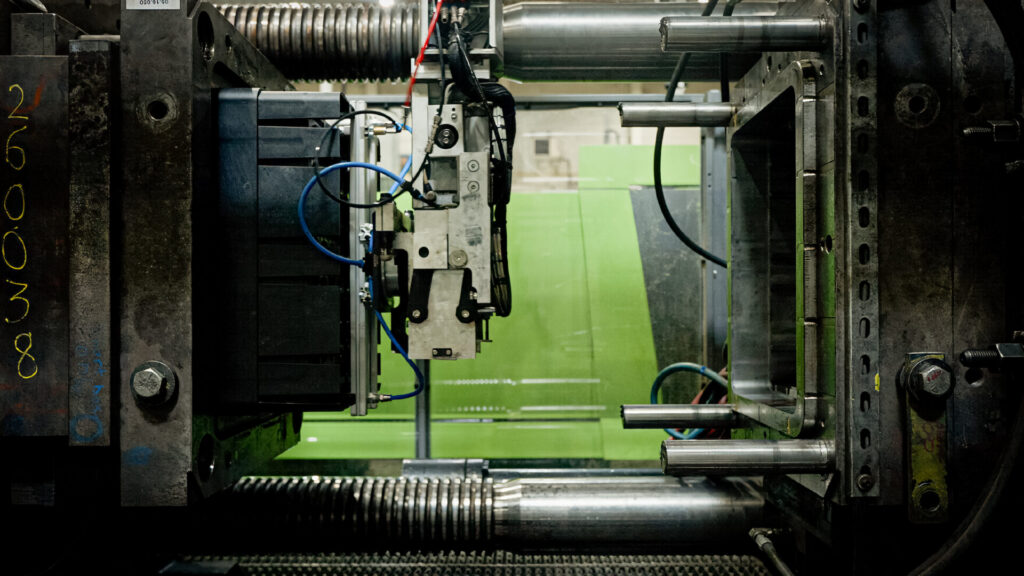
A screw in the heated barrel melts the granules into a homogeneous, liquid mass.
Injection
Under high pressure, the molten plastic fills the mould cavity in a matter of seconds.
Holding pressure and cooling
The machine maintains pressure while the part cools and takes its final shape.
Ejection
The mould opens, ejectors or a robot remove the part. The next cycle starts.
Finishing and inspection
Dimensional and visual inspection, decoration or assembly if required, and packaging for delivery.
Our machine park
The machines behind every part
Hover over an image for more information. Together, all our sites give us the capacity and flexibility to handle your project smoothly.
Injection moulding machines
Nearly 400 machines from 30 to 2300 tonnes of clamping force, for parts from 0.04 g to 9 kg.
Robots and automation
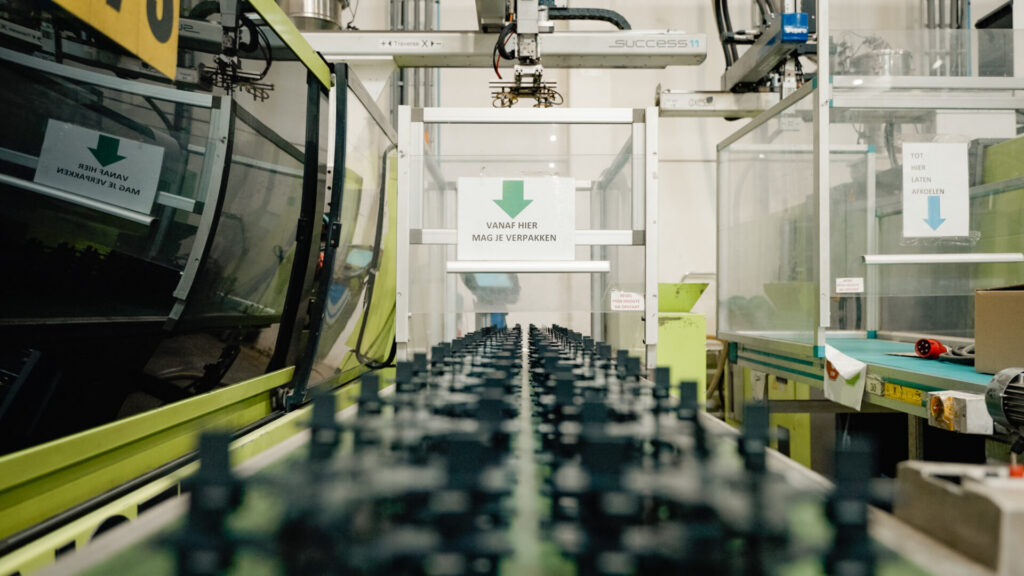
CNC and multi-axis robots remove parts, place inserts and stack the pieces.
Cleanroom production
Production in ISO class 7 (class 10,000), packaging and assembly in ISO class 8.
Moulds
In-house mould maintenance and support in the design and construction of new moulds.
Central material supply
Granules are dried centrally and fed automatically to every machine.
Decoration and assembly
Pad printing, screen printing, in-mould labelling, ultrasonic welding and assembly into a finished product.
Frequently asked questions
Questions about injection moulding
Can’t find the answer to your question here? You will find more answers on our FAQ page. Or feel free to contact us, we are happy to help.
What is the minimum and maximum part weight you can mould?
We mould parts from 0.04 grams to 9 kilograms (PP), using machines from 30 to 2300 tonnes of clamping force.
Which injection moulding techniques are available within the group?
Standard injection moulding, high-speed injection moulding (thin walls), multi-component, sandwich, gas-assisted and sequential injection moulding, and insert overmoulding.
Can you work with a mould I already have?
Yes. We inspect your mould, carry out a trial injection and then run it on the most suitable machine.
Do you also produce in a cleanroom?
Yes. Euronyl MFC produces in an ISO class 7 cleanroom (class 10,000) and packs and assembles in ISO class 8. Production is certified to ISO 13485 and HACCP.
Request a quote
Have a part in mind?
Send us your drawing or idea. Our engineers will assess its manufacturability and send you a tailored quote.